Like other large scale technological changes, new interpretations of work are altering the structure of our institutions and organizations, just as information technology has affected them in the last decades.
The concern to overcome the widespread stagnation of service-sector productivity has spawned the field called business process reengineering (BPR) and the explosive growth of a new industry devoted to workflow. According to the Gartner group, the workflow industry did about $300 million of business in the US in 1992 and is expected to reach $2.5 billion in 1996. Because workflow systems rely on common operating systems, networks, and client-server architectures, a convergence between workflow and operating systems is underway. Workflow systems are beginning to come to the attention of operating systems designers. An illustration of this is Microsoft's recent announcement that its "Enterprise Management System" would become its dominant operating system product by 1996.
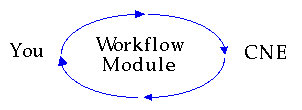
The new interpretation of work is not satisfied with using specifications and process definitions to build systems, but is instead interested in building systems, that help the user to be accomplish tasks and be more effective. Such systems are built using workflow methodologies based on mapping human committments and coordination. Such systems lead to a user's satisfaction. This new interpretation of work is signified by the logo at the top of this page.
On to Organizational Processes

MRH
9/14/94